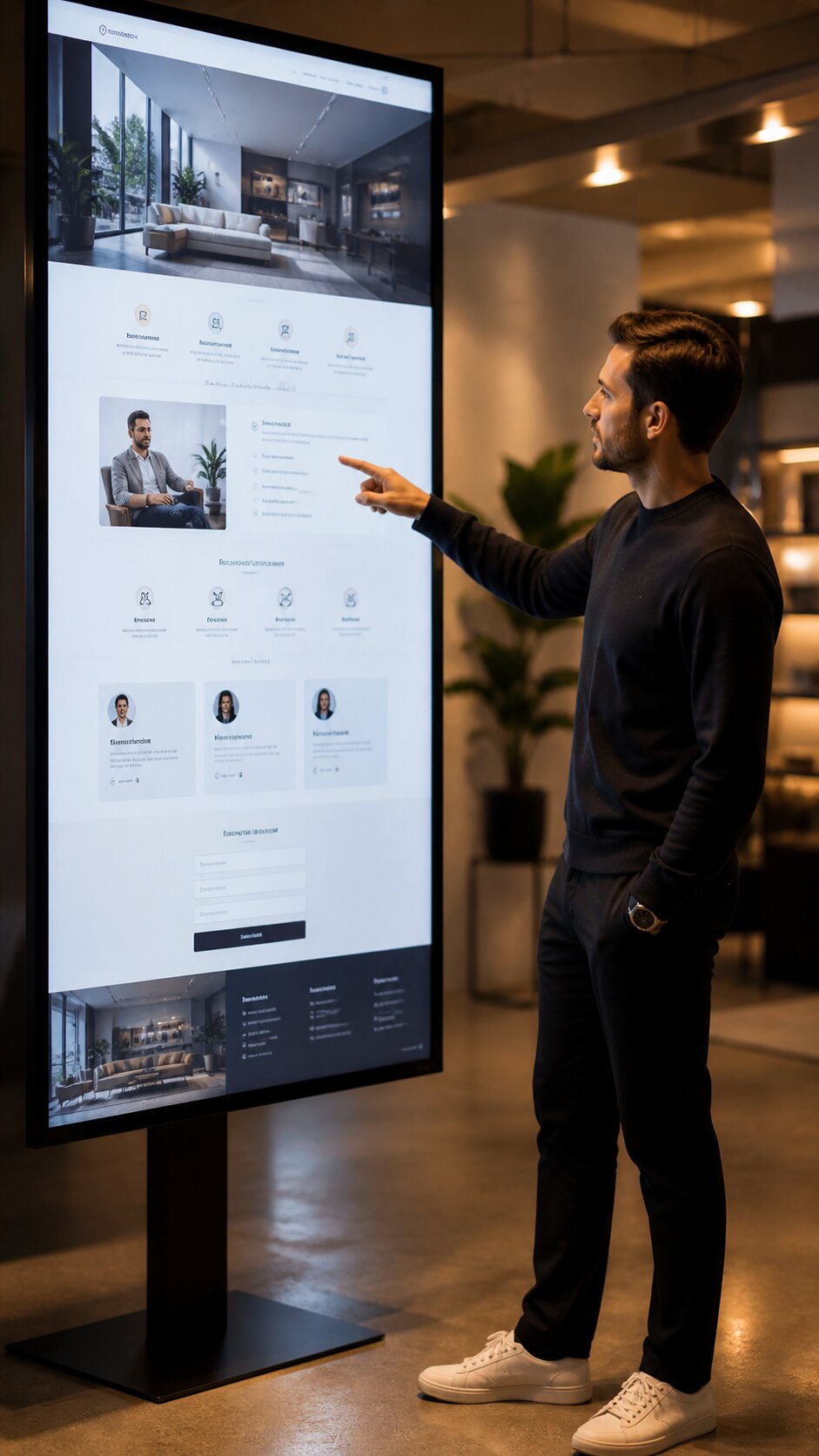
Landing Page Design: A Conversion-Focused Anatomy
Landing pages are conversion machines. Here's the anatomy that consistently works, section by section, with what to include and what to skip.
Landing pages are the simplest pages on the internet, and the hardest to design well. They have one job: convert visitors into a specific action. Every element either supports that job or hurts it.
This is the anatomy of high-converting landing pages, based on hundreds of pages we've designed and the patterns that consistently move metrics.
Section 1: Hero
What it must do
Answer "what is this?" and "why should I care?" in three seconds. If a visitor can't answer both questions in three seconds, they leave.
What it includes
- Clear, specific headline (the value proposition).
- Supporting subheadline (the context the headline needs).
- Primary CTA button (the one action you want).
- Visual proof (product screenshot, hero image, or short video, not abstract decoration).
- Optional: trust signal (logo strip, customer count, rating).
What it doesn't include
- Auto-rotating carousels.
- Vague headlines like "Welcome to [company]."
- Multiple competing CTAs.
- Stock illustrations of nothing.
Section 2: Social proof
What it must do
Reduce skepticism. Most visitors don't believe the headline by default. Social proof is the evidence that what you're claiming is true.
What it includes
- Recognizable customer logos (with permission).
- Quantified outcomes ("Reduced churn by 32%").
- Customer testimonials with names, photos, and titles.
- Press mentions or awards if relevant.
- User counts, review ratings, certifications.
The hierarchy
Specific is better than vague. "Trusted by 200+ SaaS companies" beats "Trusted by businesses worldwide." Quantified is better than testimonial. Recognizable is better than unknown.
Section 3: Features / capabilities
What it must do
Show how the product delivers the outcome promised in the hero. Each feature is evidence, not ornament.
What it includes
- 3-6 features (more becomes overwhelming).
- Feature name + outcome-focused description + visual.
- Specific examples or screenshots, not abstract icons.
The structure
The pattern that works: Outcome-led headline → One-line feature explanation → Visual proof. "Stop wasting time on manual reports" → "Automated weekly reporting pulls data from 50+ sources" → screenshot of the report.
Section 4: Use cases / differentiation
What it must do
Help visitors self-identify and understand why this product is right for them specifically.
What it includes
- Use cases organized by audience or goal ("For marketing teams," "For e-commerce stores").
- Differentiation vs. alternatives (when relevant and not petty).
- Industry-specific evidence ("Built for healthcare compliance").
Section 5: Pricing (or pricing context)
What it must do
Set expectations. Buyers who can't find pricing assume the worst. Even rough pricing context outperforms hidden pricing for most categories.
What it includes
- Clear tier names and prices, or starting price + "talk to sales" for enterprise.
- What's included at each tier.
- Most popular tier highlighted.
- FAQ addressing common pricing questions (contracts, cancelation, billing cycles).
What to avoid
"Contact us for pricing" with no anchor at all. Hidden pricing creates friction and signals you're hiding something.
Section 6: Objection handling
What it must do
Address the reasons visitors don't convert. Every category has predictable objections, the landing page should answer them.
What it includes
- FAQ section with the questions buyers actually ask.
- Trust elements: security badges, compliance certifications, money-back guarantees.
- Risk reversal: free trials, demos, or low-commitment first steps.
The pattern
Walk through your sales calls and list every objection prospects raise. Each becomes a candidate for FAQ or objection-handling content on the page.
Section 7: Final CTA
What it must do
Convert visitors who scrolled to the bottom, typically your most engaged audience.
What it includes
- Repeat the primary value proposition.
- Restate the primary CTA.
- Secondary path for visitors not ready to convert (newsletter, demo, contact).
Sections that don't belong
Founder bio sections
Unless you're selling on personal brand, founder bios distract from the conversion path. Keep them on the about page.
Big team grids
"Meet the team" sections are usually for recruiting, not conversion. Save them for the careers page.
Excessive how-it-works diagrams
One simple "how it works" section is enough. Multiple diagrams competing for attention dilute clarity.
Blog post lists
Linking to recent blog posts from the landing page splits attention away from conversion. Save blog promotion for the blog page.
Universal rules
One primary CTA, repeated
Pick the right primary action and repeat it 3-5 times throughout the page. Every other action is secondary.
Mobile-first
50%+ of landing page traffic is mobile. Design the mobile experience first, scale up to desktop. (Most landing pages are still desktop-first afterthoughts.)
Speed matters
Every second of load time costs conversion. Aggressive performance optimization is conversion optimization.
A/B test the hero
The hero section drives 60-80% of conversion outcomes. Test headline variations, CTA copy, and hero imagery. Most other tests have smaller effects.
The closing principle
Landing pages reward ruthless prioritization. Every section either earns its place by moving conversion or it doesn't. The pages that perform are usually the ones where you cut more than you added.
If you're working on a landing page that needs to move conversion, we can help design or audit.